How to Use a Compost Tumbler to Turn Scraps Into Garden Nutrients

1.8K
165
62
2025-10-18
How to Use a Compost Tumbler to Turn Scraps Into Garden Nutrients

When you know how to use a compost tumbler correctly, you can make compost faster than with stationary compost bins. Compost bins and tumblers work in the same way. They allow microorganisms to transform kitchen scraps and garden wastes into a nutrient-rich soil amendment. They require both "brown matter" (high in carbon), such as straw, shredded paper, sawdust, and pine needles, and "green matter" (high in nitrogen), which includes vegetable and fruit waste from the kitchen, fresh seed-free weeds, and fresh grass clippings. The ideal ratio is about three to four parts brown to one part green. If you add too much green material, composting slows down, resulting in a soggy mess. You may find that a paper shredder is just the ticket for adding lots of brown matter. If you used to shred paper for security; now, shred it to feed your compost. 

Compost Tumbler vs. Compost Bin

A few major differences exist between a compost tumbler and compost bins that don't move. The biggest benefit of a compost tumbler is how easy it is to turn your compost. Turning helps speed up composting by adding oxygen—another requirement for those hardworking microorganisms—to the mix. Turning compost in a bin is strenuous work, usually done with a garden fork or shovel. It can take a lot of time and result in a tired or sore back if you get too carried away.

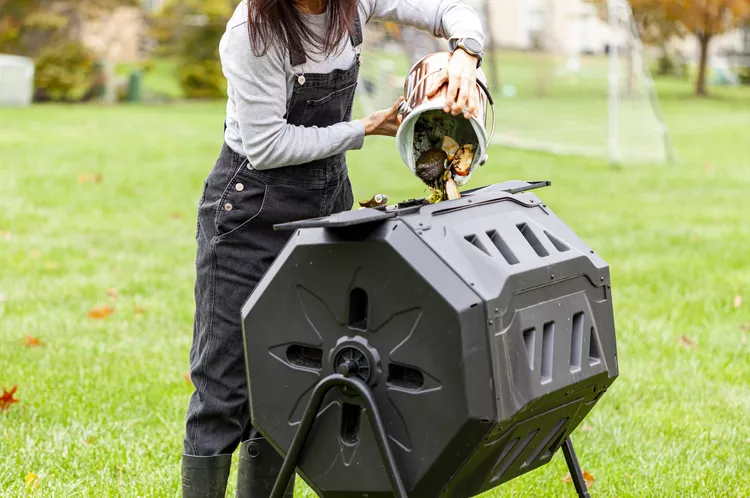
In contrast, a compost tumbler is built to be turned. The drum sits on an axis—either vertically or horizontally—with handles that allow you to turn the drum with a lot less effort. Turning it a couple of times a week keeps the process moving along. That said, the fuller the drum, the harder it becomes to turn. But it's still a breeze compared to turning compost in a bin with a garden fork, and it literally only takes a minute.

Compared to open compost bin systems, compost tumblers are closed systems that offer several advantages. While tumblers have ventilation holes that allow air in and excess moisture out, these are small enough to keep out unwanted critters. In general, compost tumblers are easier to keep tidy and have a small footprint, which makes them suitable for smaller suburban/urban yards.

Types of Compost Tumblers

While most tumblers sit on an axis or within a frame, some sit on the ground where they can be rolled. The drum of a tumbler on an axis may be oriented vertically or horizontally. Compost tumblers come in various sizes, so you'll want to consider how much kitchen waste you generate and the space available when making your choice. 

The most important feature to consider in a compost tumbler is the benefit of a dual chamber. If you have a single-chamber compost tumbler, you must wait once that chamber is full for the compost in it to mature before adding more scraps. This takes about two months, and unless you have a second tumbler, a lot of kitchen scraps will be sent to the landfill.

If you have a dual-chambered tumbler, you can start the process again in the second chamber as soon as you’ve filled the first. Often, the time it takes to fill the second chamber is about the same time it takes for the first chamber to become usable.

How to Use a Compost Tumbler

Place your tumbler in a sunny location in your yard. This helps add heat to the drum to speed up decomposition. Add brown and green waste material you want to compost. You can add this material to your tumbling composter all at once or over time. Put in kitchen waste as you generate it, adding sufficient shredded paper to keep it in balance. Cut up the kitchen waste into small pieces if you wish to speed up the process. 

Turn the tumbler every three to five days. If it seems dry, pour in a bit of water. When the tumbler is about three-quarters full, stop adding new material but keep turning it regularly. Depending on the temperature, your compost should be finished in six to eight weeks (maybe a little longer in the winter). 

How you remove the finished compost depends on the design of your tumbler. For some models, you can roll a wheelbarrow directly under the opening and turn it so the compost spills out. Or you can use a narrow shovel to scoop out the finished compost. If you find a few bits that are not entirely composted, just leave them; they’ll finish breaking down in the next cycle. Using a compost sifter will help remove larger pieces that need more time. It’s also a good idea to leave some of the finished compost in the chamber for the next batch to be sure you have a starter supply of good microbes.
Related Article

6 Tips for Creating a Low-Maintenance Cottage Garden
22.5K
1.3K
283

6 Tips for Creating a Low-Maintenance Cottage Garden

Cottage gardens are intentionally casual. Go big on color, but light on labor with this classic, informal garden style.
How to Use a Compost Tumbler to Turn Scraps Into Garden Nutrients
1.8K
165
62

How to Use a Compost Tumbler to Turn Scraps Into Garden Nutrients

Learn how to use a compost tumbler to quickly turn your kitchen waste into valuable organic matter for your plants.
15 Easy Annuals You Can Grow from Seed
7K
556
61

15 Easy Annuals You Can Grow from Seed

Find out which annuals are easy to grow from seed for their beautiful flowers, along with tips on when and how to sow them.
How to Grow Basil Indoors to Enjoy All Year Long
30K
898
350

How to Grow Basil Indoors to Enjoy All Year Long

Growing basil indoors is easy to do from seeds or cuttings. Learn how to grow basil indoors in potting mix or water.
The 10 Best Types of Gourds to Grow for Decor, Crafts, and More
44.7K
1.8K
447

The 10 Best Types of Gourds to Grow for Decor, Crafts, and More

Types of gourds come in many colors, shapes, and sizes. Find the best ones to grow in your garden, how to harvest gourds, and what to use them for.
21 Best Vegetables to Grow in Pots
22.8K
1.1K
136

21 Best Vegetables to Grow in Pots

Choose from these vegetables to grow in pots to enjoy plenty of homegrown produce even from a small space. From petite tomato plants to mini melons, this list includes 21 tasty options that will thrive in containers.
7 Tomato Plant Pests and How to Get Rid of Them
23.1K
461
138

7 Tomato Plant Pests and How to Get Rid of Them

These tomato pests can take a big bite out of your harvest. Use these tips to keep them under control.

8 Expert Tips on How to Keep Squirrels Out of Bird Feeders
30.7K
3.1K
983

8 Expert Tips on How to Keep Squirrels Out of Bird Feeders

These tips from experts on how to keep squirrels out of bird feeders ensure a cleaner outdoor space and only birds at your feeder.
What Are Leafhoppers and How to Get Rid of These Pests
49.2K
1.5K
664

What Are Leafhoppers and How to Get Rid of These Pests

Leafhoppers can damage plants and spread diseases, but there are several ways to control these insect pests. Find out the best ways to get rid of leafhoppers and prevent infestations organically with these tips.
How Can I Stop Woodchucks From Eating My Flowers and Plants?
31.7K
2.9K
656

How Can I Stop Woodchucks From Eating My Flowers and Plants?

How do I stop woodchucks from eating my flowers and plants?
How to Plant and Grow Begonias
46K
3.2K
741

How to Plant and Grow Begonias

Learn how to grow versatile begonias for an easy-care addition to your garden design.
How to Press Flowers for a Pretty Memento You’ll Want to Display
29K
289
34

How to Press Flowers for a Pretty Memento You’ll Want to Display

Preserve your favorite flowers by pressing them with materials you have around your house.
10 Red Flowers for Big, Bold Color in Your Garden
31.6K
2.8K
397

10 Red Flowers for Big, Bold Color in Your Garden

Add an eye-popping assortment of red flowers to your garden, and you'll be thrilled with the bold color they add to your landscape.
23 Plants with Silver Foliage to Help Your Garden Shine
45.5K
2.7K
1K

23 Plants with Silver Foliage to Help Your Garden Shine

Silver leaves set off more colorful flowers and brighten your landscape. Here are the best plants with silver foliage to grow.
15 Rooftop Plants That Will Elevate Your Your Garden
48.8K
1.5K
570

15 Rooftop Plants That Will Elevate Your Your Garden

From groundcovers to shrubs and small trees, these top-notch rooftop plants thrive despite tough growing conditions such as high winds found at higher elevations.
36 Container Garden Ideas to Inspire Your Own Pretty Plantings
46.6K
2.8K
1.4K

36 Container Garden Ideas to Inspire Your Own Pretty Plantings

Use these container garden ideas to create the best-designed planter for your patio, window box, or other container planting.
Top Butterfly Container Garden Ideas
37.7K
2.3K
294

Top Butterfly Container Garden Ideas

Bring butterflies to your garden—even if you have just a deck or patio—with these easy container recipes.
10 Front Porch Planter Ideas to Drape Your Entryway in Color
25.2K
252
110

10 Front Porch Planter Ideas to Drape Your Entryway in Color

Get inspiration and tips for combining containers and plants with these front porch planter ideas to create maximum curb appeal and match your style.
The 3 Best Types of Berries to Grow in Containers, and How to Grow Them
8K
799
167

The 3 Best Types of Berries to Grow in Containers, and How to Grow Them

These essential tips for growing raspberries in pots can also be used to grow strawberries and blueberries. Here's what you need for a sweet crop.
6 Must-Know Tips on Mandevilla Care in Pots to Keep the Flowers Coming All Summer
4.2K
211
78

6 Must-Know Tips on Mandevilla Care in Pots to Keep the Flowers Coming All Summer

Mandevilla care in pots is a little different than growing these gorgeous summer-blooming plants in the ground. Use these tips to keep your potted mandevilla plant thriving and flowering all season.