
When you see holes in your basil leaves, missing leaves, or even completely missing plants, you may be wondering, "What's eating my basil plant?" This popular herb is commonly assumed to be immune from leaf-munching pests, but that isn't entirely accurate. If it isn't a neighbor sneaking over to borrow some basil, here are a few other possible culprits, what to look for, and how to solve the problem.
Common Basil Pests
Basil pests are usually insects that don't mind the scented leaves and are happy to munch on the tender foliage. Like with most garden pests, your best defense is a frequent garden walk, inspecting to catch problems earlier rather than after a catastrophic defoliating.
A few munched leaves here and there are no cause for concern, but if you notice significant damage to your basil, it could be one of the following pests.
1. Japanese Beetles
These shiny, metallic-green beetles are about half an inch long, with brown or copper-colored wing covers on their back. They're pretty easy to spot in sunlight because of their iridescent coloring and larger size (for a bug). Japanese beetles overwinter as white grubs in the soil and emerge from the ground about mid-summer.
Adult beetles feed on the upper leaves of many plants, including basil. They eat the softer leaf tissue between the veins, leaving behind a lace or skeleton-like munched leaf. If Japanese beetles are eating your basil plants, try:
- Handpicking and dropping them into a bucket of soapy water.
- Using fine netting such as a floating row cover to protect plants (if they need pollination, this won't work well).
Avoid using Japanese beetle traps. These traps were developed for researchers and can actually attract more beetles to your yard by emitting attractive female pheromones.
2. Slugs
These garden pests are similar to snails without shells. Slugs are soft-bodied and slimy, with no legs. Most are brown or gray colored, and their head has two pairs of feelers, one for sight and one for smell. Slugs are nocturnal and do their damage at night when they're hard for us to spot.
Look for dried slime trails in your garden–they sometimes shine in the morning sunlight. Other signs of slug attack include irregularly shaped holes in leaves and fruit. To combat slugs:
- Use a flashlight at night or look underneath plants during the day. Check under the mulch, too.
- Drop them into a bucket of soapy water or otherwise remove them.
- Set beer traps.
- Lay out flat boards in the garden, then check for slugs and dispose of them the next morning.
- Keep basil up off the ground in a container to limit feeding opportunities.
3. Aphids
Aphids are small, soft-bodied insects. They’re typically only 1/8-inch long and may be almost any color, from green and black to red, yellow, or gray. They use needle-like mouthparts to pierce plants and feed on the sap.
Aphid damage is often not a matter of great concern in the garden, but signs of severe feeding damage include twisted and curled leaves, stunted shoots, poor growth, and yellowed leaves. Look for honeydew, a sticky, clear, and shiny substance they secrete when feeding. To fight off aphids:
- Knock them off plants with a strong spray from your garden hose. Aphids are weak and often won't climb back up.
- Encourage their enemies, like lady beetles and lacewings, by avoiding pesticides and planting flowers that attract beneficial insects that prey on pests.
4. Caterpillars
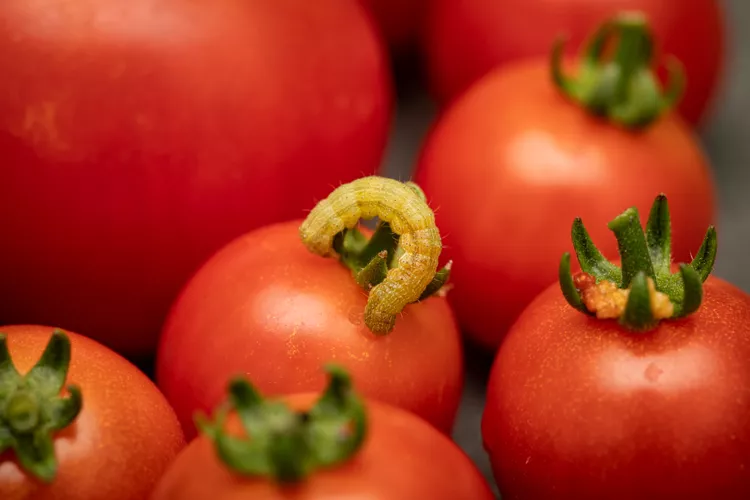
Caterpillars are definite leaf munchers, and some, like the tomato hornworm, can devour a plant in a matter of hours. Most often, caterpillars are not a big threat. As we learned in grade school, caterpillars are the immature stage of butterflies and moths. As such, you may not want to harm them.
Feeding damage from caterpillars often looks like ragged holes in leaves or portions of leaves eaten. During the day, look for caterpillars on the undersides of leaves and stems, where they often hide. If you do need to remove caterpillars from your garden:
- Handpick and relocate them to a non-problem area.
- Cover plants with insect barrier fabric like a row cover to prevent the adults from laying eggs. Remove the fabric for pollination.
5. Katydids
Katydids are often camouflaged and green in color and blend in well with foliage. Their size varies from a half-inch long to grasshopper-sized or a little larger. Katydids have long, grasshopper-like back legs, very long antennae in relation to their body, and hold or fold their wings vertically over their body. They have chewing mouthparts.
Feeding damage from katydid adults and nymphs looks like holes chewed in the leaves. While the smaller nymphs frequently feed from the middle of the leaf, adults often start at the leaf edge and work their way in. To combat katydids in your basil:
- Catch them by hand and dispose of them.
- Hunt during the day. Katydids rest during the day and can be easier to snag than in the evening. If they're too quick, wait for a cool morning when they move slower.
6. Rabbits
Rabbits seldom damage basil planted in the garden, but no plant is guaranteed rabbit-proof. If it's a bunny that's snacking on your basil, you'll see clean-cut, angled slices (from their sharp teeth) on stems and, of course, rabbit droppings. Prevent rabbit damage by:
- Growing basil in tall pots to keep them out of reach of rabbits.
- Using a repellent on your plants frequently.
7. Deer
Deer also won't typically bother basil or other strongly scented plants. While they may grab a taste test, that's about the limit to the damage because the animals quickly figure out basil is not a preferred flavor. Deer damage on plants looks like a torn stem, missing top, or even a whole plant ripped out of the ground. Hoof prints are a good sign deer have been there. To keep deer at bay:
- Use deer repellent frequently, making sure to switch the type you use every few weeks.
- Install tall fencing around the part of your garden you want to protect, or your whole yard if that's an option.